
Laser deposition welding
in industrial use
Laser powder cladding: Process for precise, reproducible &
economical repairs of metallic components.
Laser powder cladding:
The procedure in detail
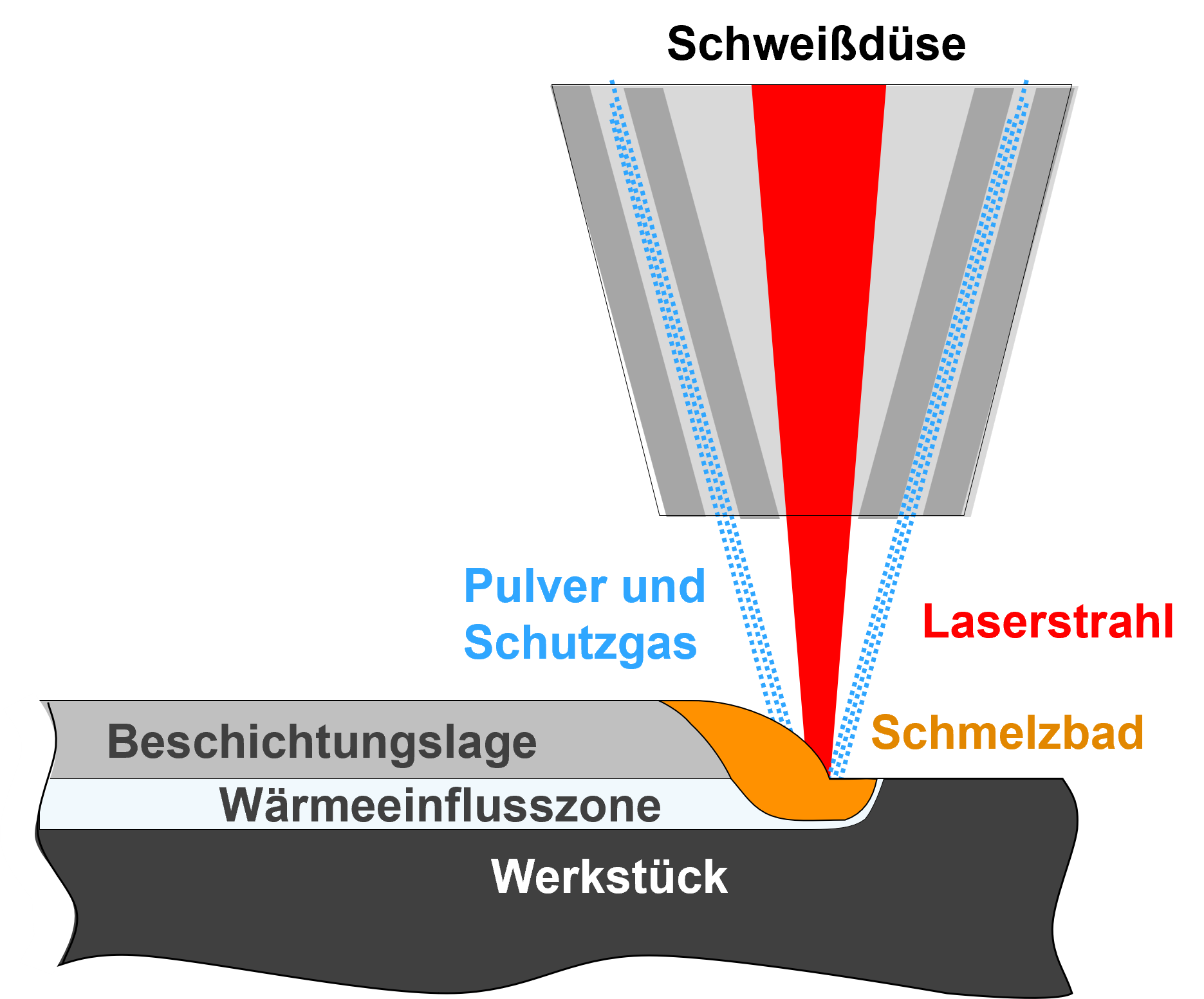
Laser powder cladding is a technically advanced manufacturing process in which metal powder is applied to a workpiece in layers using a precisely focussed laser beam and is firmly fused to the base material. The result is a dense, metallurgically bonded layer that permanently resists wear, corrosion and mechanical and thermal stress.
The technology
Compared to conventional welding processes, laser cladding works with minimal heat input, which minimises distortion, cracking and structural changes. This means that high-quality components from the mechanical engineering, energy or pulp industries can be repaired or optimised cost-effectively without losing their original geometry.
Typical layer thicknesses are in the range of 0.7 and 1.2 mm, with multi-layer welds up to several millimetres. The process is suitable for localised repairs as well as for large-area coatings
The right filler metal for every requirement
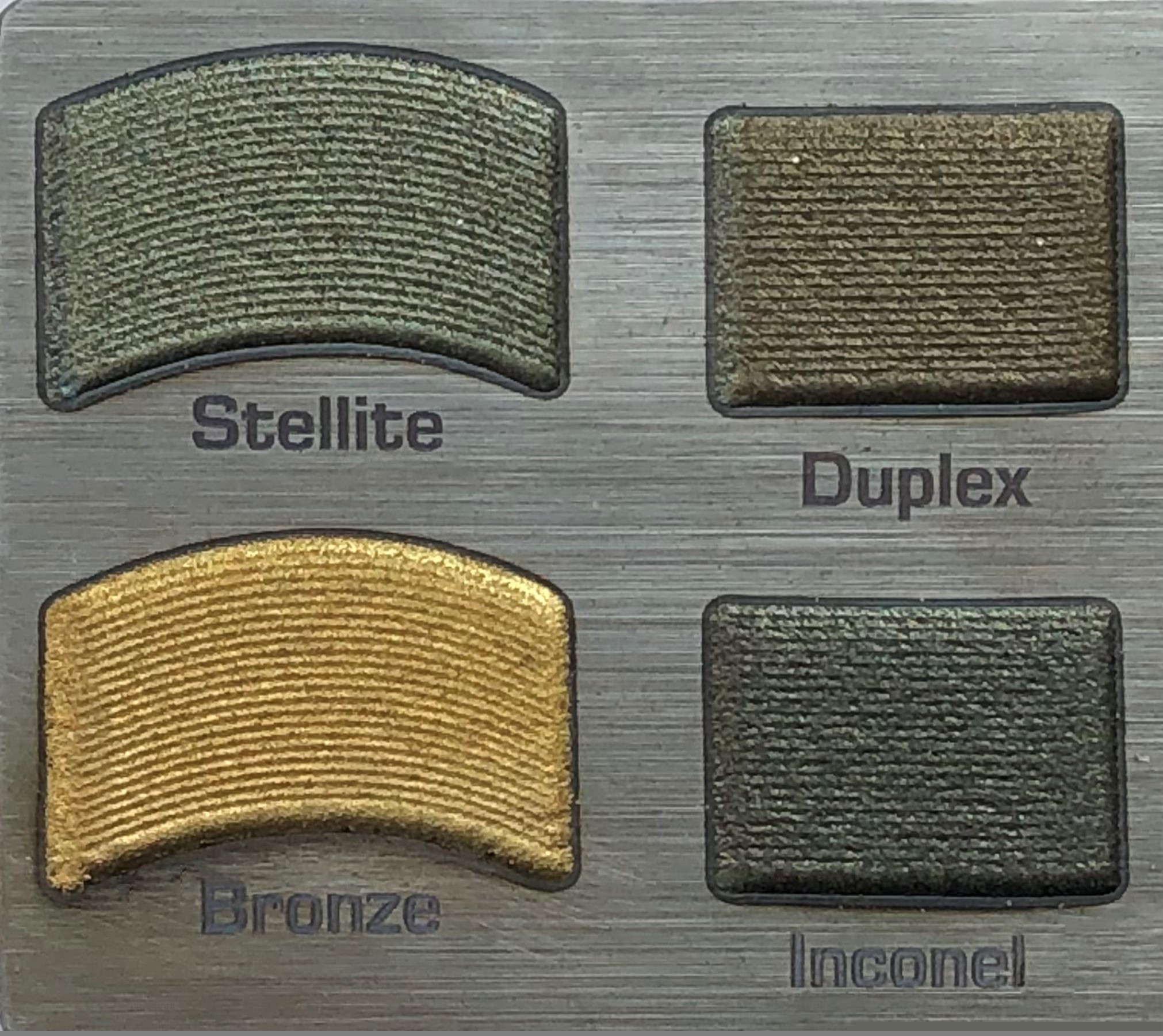
Different alloys and powder types are used depending on the stress and environment. LaserCladding Austria processes a wide range of materials - from standard alloys to highly specialised powders for the most demanding requirements.
Typical base materials:
- Steel
- CrNi steel
- Cast iron (GGG / GJS)
- Aluminium
- Bronze
Typical filler materials:
Steel alloys (various types)
Nickel alloys (e.g. Inconel®, Invar®)
Cobalt alloys (e.g. Stellite®)
Aluminium alloys
Bronze alloys
Other filler materials on request
Laser powder cladding
Advantages at a glance
Your economic advantages
- Significant cost savings through targeted repairs instead of new production
- Reduction of downtimes
- Short delivery times and flexible project management
- Tailored properties: Components with customised layer properties
- Conserving resources by reusing existing components
Your technical advantages
- Restoration of damaged surfaces or contours
- Increased wear and corrosion resistance
- Extension of product service life
- Local, component-optimised application - only where necessary
- Generation of new functions through additive elements or functional surfaces
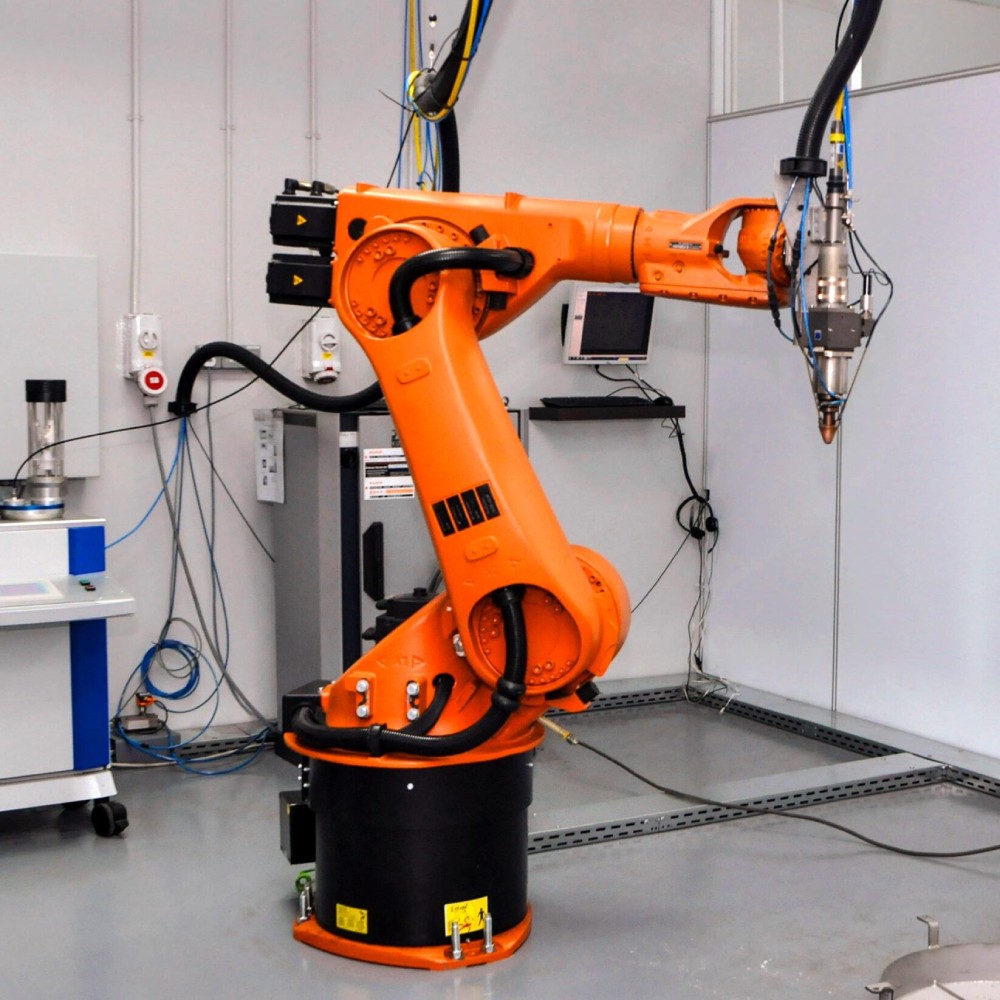
Precision thanks to state-of-the-art KUKA robotics
LaserCladding Austria uses an automated KUKA robot system with multi-axis control, which ensures high repeat accuracy and stable process conditions.
Laser power, powder feed and feed speed are precisely controlled via integrated sensors.
The result: uniform layer geometries, precise contours and documented process quality - both stationary in the workshop and mobile on the customer's premises.
Research and development
in the LaserCladding Group
Laser powder cladding can look back on more than 20 years of intensive research and development work. Gall & Seitz Systems, in co-operation with Trumpf and the Bremen Institute for Applied Beam Technology (BIAS), played a key role in driving this development forward.
Originally designed for applications in the maritime sector, laser cladding has now established itself as a key technology in numerous industrial sectors.
The technical advantages - in particular the metallurgical bonding to the base material, the high dimensional accuracy, the small heat-affected zone and the pronounced durability of the components - make laser cladding a superior alternative to conventional welding processes.
Today, LaserCladding Austria is one of the companies that is consistently pursuing this development. With well-founded application expertise, the company successfully transfers the technology into industrial practice and actively drives its continuous further development.
Differentiation from alternative build-up welding processes
Several methods are available for repairing metal components, including plasma powder cladding and various thermal spraying techniques.
While these processes often generate larger melt pools or broader energy inputs, laser powder cladding works in a much more localised and controlled manner. The process parameters can be precisely controlled, allowing the layer geometry to be precisely guided and the microstructure to be specifically influenced.
This makes laser cladding particularly suitable for components where tight tolerances, localised coatings or minimal heat input are crucial.
Machine downtime? Contact our emergency service now!
Whether it's a planned shutdown or an acute failure, our emergency repair welding service allows us to respond quickly and reliably. We quickly check your component, advise on the optimum repair method and prepare a quotation.
Quality assurance for laser powder cladding
LaserCladding Austria works according to clearly defined quality standards and test procedures. Every order is documented and checked from the receipt of material to the finished layer
Test steps and procedures:
1.
Visual and metallurgical layer inspection
2.
Hardness measurement and tensile adhesion test
3.
3D measurement and layer thickness control
4.
Documented quality in accordance with ISO and DNV standards
5.
Regular training for specialised staff
6.
Close cooperation with partners from research and industry
This results in verifiable quality, which is crucial in safety-relevant applications such as turbine or generator construction.
Laser cladding use in industrial sectors
Laser powder cladding is used in numerous industrial areas where wear, corrosion or material fatigue play a role:
Energy and power plant industry
(e.g. turbines, generators, pumps)
Pulp and paper industry
(e.g. shafts, rollers)
Mechanical and plant engineering
Metal processing and foundry technology
Chemical and petrochemical industry
Components from vehicle and construction machinery construction
Technology that connects:
Get in touch with us
With decades of group expertise and its own mobile plant technology, LaserCladding Austria offers a combination of technology, experience and flexibility that is unique in this form.
Each project is planned individually - from damage analysis to ready-to-install repairs.
FAQ - Frequently asked questions about laser cladding technology
What is laser powder cladding?
Laser powder cladding is a coating process. Laser radiation is used to create a molten pool and additional metal powder is melted onto it. This allows metallic components to be repaired or refined.
What are the advantages of laser cladding over conventional repair methods?
By minimising heat input, components remain dimensionally stable and distortion-free. This means that damaged components can be reconditioned cost-effectively and to the highest quality.
Which materials can be processed with laser metal deposition?
Typical materials are steel, Cr-Ni steel, cast iron, aluminium and bronze. Depending on the requirements, different powder alloys are used as filler materials.
Where is laser cladding technology used?
This key technology is now used for repair and finishing purposes in all industrial sectors. This process is of particular economic interest in the fields of rotating equipment, cast housings and drive technology.
Can LaserCladding Austria also weld on site?
Yes, LaserCladding Austria also offers mobile laser powder cladding directly at the customer's premises using a system developed in-house - ideal for large or difficult-to-transport components.
→ Learn more: Mobile laser metal deposition
 German
  English